Loading...

Additive manufacturing creates physical components by building material layer by layer from a digital 3D model. In vehicle manufacturing, the technology is used for prototypes, production tools, manufacturing aids, replacement parts and selected end use components.
Unlike processes that require dedicated moulds, dies or extensive machining, additive manufacturing can produce a part directly from a digital file. This can help manufacturers respond more quickly to design changes and produce small quantities without investing in conventional tooling for every component.
Prototyping remains one of the main applications of additive manufacturing in the vehicle industry. Engineers can produce concept models and functional prototypes directly from CAD data to evaluate dimensions, installation, appearance and performance.
For bus manufacturers and bodybuilders, this can support the development of interior components, brackets, housings, ducts, panels and vehicle specific mounting solutions. Designs can be revised and printed again without waiting for new tooling, helping engineering teams identify issues earlier in the development process.
Additive manufacturing is also used to produce assembly fixtures, checking tools, drill guides, gauges and other manufacturing aids.
Polymer tools can replace heavier machined alternatives in suitable applications. Their lower weight can improve handling for production workers and reduce loads on robotic systems and other equipment.
Digital production also makes it easier to modify a tool when a component or vehicle design changes. This can be useful for bus production, where different vehicle lengths, interior layouts and customer specifications may require customised assembly tools.
Additive manufacturing allows engineers to create geometries that may be difficult to produce through conventional machining or moulding. Material can be placed only where it is structurally required, while internal lattice structures can further reduce mass.
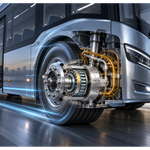
Potential bus applications include brackets, electronic housings, air ducts, interior structures and selected thermal management components. Reducing component weight may contribute to lower vehicle mass, although the effect on fuel consumption or electric range depends on the complete vehicle design and operating conditions.
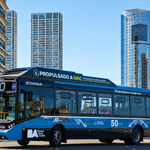
Bus and coach production often involves lower volumes and more configuration options than high volume passenger car manufacturing. Additive manufacturing can therefore be useful for specialised parts, customised interiors, limited production programmes and components that would not justify dedicated conventional tooling.
Manufacturers can produce different versions of a component from separate digital files without creating a new mould for each variant. This provides greater flexibility for vehicle specific requirements and small production batches.
Instead of storing every low demand replacement part in a warehouse, manufacturers can retain approved digital models and produce certain parts when they are required.
This approach can support older buses, specialised vehicles and components with unpredictable demand. It may reduce physical inventory requirements and help extend aftermarket support after conventional tooling is no longer available.
However, digital spare part production requires controlled files, approved materials, defined printing parameters and consistent quality assurance.
Additive manufacturing is not a replacement for every conventional process. Injection moulding, stamping and other established methods generally remain more economical for large quantities of identical parts.
Material strength, temperature resistance, chemical resistance, durability, surface finish and dimensional accuracy must be evaluated for each application. Production components also require documented process repeatability and appropriate validation.
For regulated or safety related applications, manufacturers must confirm that the selected material, printing process, finishing method and inspection procedure meet the relevant engineering and vehicle requirements.
Additive manufacturing is moving beyond rapid prototyping and becoming part of wider vehicle development and manufacturing strategies.
For the bus and coach sector, its strongest value lies in accelerating design validation, producing lighter manufacturing aids, supporting customised low volume production and enabling controlled digital spare part inventories. Its successful use depends on selecting applications where design flexibility and shorter lead times provide a clear advantage over conventional production.